My Journey Through the TNMGRMU AYUSH Research & Biostatistics Workshop 2025
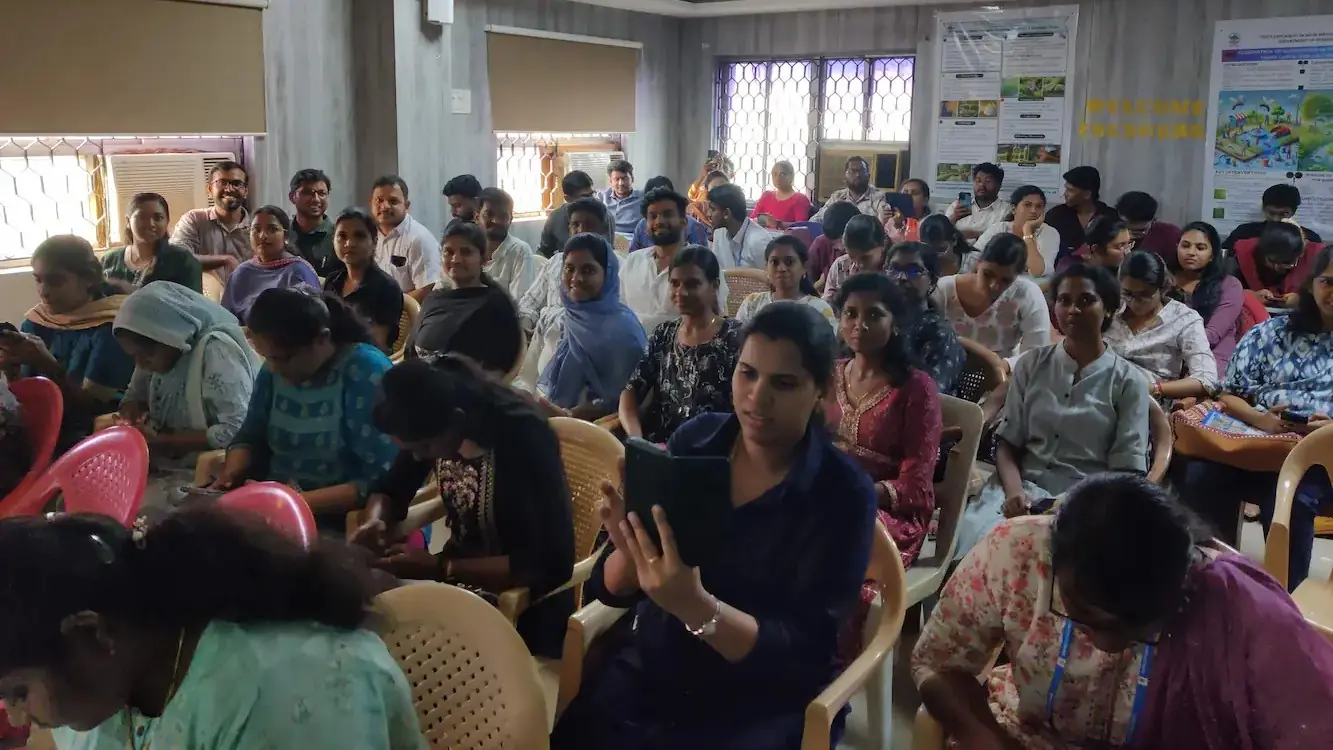
Embarking on postgraduate studies in Homoeopathy, the call to rigorous, evidence-based research becomes ever more pronounced. This three-day workshop by TNMGRMU's Department of Epidemiology was not just a series of lectures, but a transformative experience. It provided the crucial scaffolding—both conceptual and practical—to navigate the complexities of research. This article is my attempt to distill the essence of those invaluable sessions, sharing key learnings and personal takeaways.
Day 1: Architecting the Research Blueprint
The inaugural day masterfully laid the foundational stones, moving from the 'why' of research in AYUSH to the 'how' of formulating questions, navigating literature, designing instruments, understanding basic statistics, and upholding ethical tenets.
Introduction to Research in AYUSH: Bridging Tradition with Evidence
Speaker: Dr. N. Kabilan (Prof & HoD, DoS, TNMGRMU)
Dr. Kabilan's opening address was a powerful reminder of our responsibility as AYUSH practitioners to contribute to the scientific validation and evolution of our systems.
- The "Why" of AYUSH Research: Beyond academic necessity, it's about enhancing patient care, informing policy, and ensuring AYUSH systems earn their rightful place in integrative healthcare.
- AYUSH Systems - A Tapestry of Healing: Celebrated the unique philosophies of each system while underscoring the common thread of holistic, patient-centered care, with Homoeopathy's individualized approach as a prime example.
- The Imperative of Interdisciplinary Synergy: Advocated for "breaking silos" – robust collaborations with conventional medicine, basic sciences, and even social sciences to tackle complex health challenges.
Dr. Kabilan's Core Message: "Research is not an esoteric pursuit but a vital tool to refine, validate, and expand the reach of AYUSH knowledge for global well-being."
From Spark to Specificity: Crafting Research Questions
Speaker: Dr. Maanasa Rajagopalan (NIE)
Dr. Maanasa brilliantly demystified the art of formulating a research question – the cornerstone of any study.
The Genesis of Inquiry:
- The Research Cycle: From observation to question, hypothesis, study, analysis, and new questions.
- FINER & PICO(T): Practical sieves to refine raw ideas into robust, answerable questions (e.g., for Homoeopathy: Patient characteristics, specific Remedy/Intervention, Comparison like placebo/other remedy, Outcome, Time).
Translating & Refining:
- Question to Objective: The crucial step of converting the "what" (question) to "how and what will be measured" (SMART objectives).
- Types Demystified: Descriptive (What is the profile of...), Associative (Is X related to Y?), Causal (Does X cause/improve Y?).
Key Insight: A research question isn't set in stone. It evolves with deeper literature understanding and preliminary exploration. Be prepared to refine!
Mastering the Maze: Literature Search & Organization
Speaker: Ms. Sandhya Bharathi (SRMC)
Ms. Sandhya equipped us with a veritable arsenal for conquering the literature review.
Targeted Search Strategies:
- Database Deep Dive: Beyond PubMed, exploring Cochrane, AYUSH Portal, DHARA, Scopus. Emphasis on using
MeSH termseffectively. - Boolean Brilliance: Practical use of
AND,OR,NOT. Example:(Homoeopathy OR Homeopathy) AND "Low Back Pain" AND RCT. - Citation Chaining: Snowballing from key papers.
 Literature Search Tools, Databases, and AI Assistants
Modern Tools & Organization:
- AI Companions: Leveraging tools like SciSpace, Perplexity AI, Elicit for discovery and summarization (not replacement of critical reading!).
- Reference Managers: Zotero and Mendeley are non-negotiable for sanity. Practice APA initially, then convert.
- Systematic Review Data Sheet: Crucial structure for meta-analysis prep (Title, Year, Abstract, Method, Result, Aim, Database).
Pro-Tip: Don't just summarize; synthesize. Identify gaps, controversies, and emerging themes. This forms the strongest rationale for your study.
The Art of Asking: Crafting Effective Questionnaires
Speaker: Ms. Sivaranjani
A questionnaire is a precision instrument; its design dictates data quality.
- Question Types: When to use open-ended (rich qualitative data) vs. closed-ended (quantifiable, easier analysis). Nuances of Likert scales, semantic differentials.
- The "Don'ts" of Wording: Avoid jargon, ambiguity, double-barreled questions (e.g., "Is the remedy effective and safe?"), and leading questions. Clarity is king!
- Logical Flow & Aesthetics: Start broad, then specific. Group similar items. Make it visually appealing.
- Pilot Testing - The Unskippable Step: Test on a small, similar sample to catch confusing items, estimate time, and refine.
Statistics Without Tears: Concepts & Test Selection
Speaker: Dr. Vasantha (NIRT, ICMR)
Dr. Vasantha masterfully broke down foundational statistical concepts, focusing on intuition over complex formulae.
Describing vs. Inferring:
- Descriptive Stats: Painting a picture of your sample (mean, median, mode, SD, range, frequencies).
- Inferential Stats: Drawing conclusions about the population from your sample (hypothesis tests, CIs).
- Data Types Rule: Nominal (categories), Ordinal (ordered), Interval (equal intervals, no true zero), Ratio (true zero) – understanding this is critical for test choice.
Hypothesis Testing Essentials:
- Null (H0) vs. Alternative (H1): The scientific tug-of-war.
- P-value: Probability of seeing your data (or more extreme) if H0 is true. Not the probability H0 is true!
- Errors: Type I (α, false alarm) & Type II (β, missed detection). Power = 1-β.
- Parametric vs. Non-Parametric: Guided by data distribution (normality tests like Shapiro-Wilk) and data type.
Statistical Mantra: "Your research question dictates your variables; your variable types and data distribution dictate your statistical test."
The Moral Compass: Ethics in Health Research
Speaker: Dr. K.S. Uma (TNMGRMU)
A profound exploration of the ethical bedrock upon which all credible research must stand.
- Historical Echoes: The Tuskegee Syphilis Study wasn't just a historical event but a stark reminder of why ethical oversight (Nuremberg, Helsinki, Belmont) is paramount.
- Pillars of Ethics: Autonomy (true informed consent), Beneficence (do good), Non-maleficence (do no harm), Justice (fairness in selection/benefits).
- IEC/IRB: Not a hurdle, but a collaborative partner to ensure research integrity.
- AYUSH Ethical Considerations: Sensitive handling of traditional knowledge, placebo rationale in Homoeopathy, ensuring community benefit.
Day 2: Mastering Study Design & Methodological Precision
Day two ventured into the intricate world of study architecture. We explored various research designs, the meticulous craft of protocol writing, the nuances of interventional studies, and the practicalities of operational research and sample size determination.
 Group Photo at the Entrance
Choosing Your Lens: An Overview of Research Designs
Speaker: Dr. A. Vigneswari (SRMC)
Dr. Vigneswari skillfully navigated the landscape of research designs, emphasizing that the choice is dictated by the research question and feasibility.
- Qualitative vs. Quantitative: Exploring "why" and "how" vs. measuring "how much" or "how often."
- Observational vs. Experimental: Observing nature vs. actively intervening.
- Descriptive: Case Reports/Series, Cross-Sectional (snapshot for prevalence).
- Analytical (Observational): Case-Control (retrospective), Cohort (prospective/retrospective).
- Experimental: RCTs (gold standard for causality), Quasi-experimental.
The Research Roadmap: Crafting Protocols & Concept Papers
Speaker: Dr. Premalatha
Dr. Premalatha underscored the protocol as the non-negotiable blueprint for any research endeavor.
- Protocol's Purpose: Ensures clarity, reproducibility, ethical adherence, and serves as a guide for the entire team.
- Essential Components: Detailed breakdown of Title, Abstract, Intro/Rationale, Objectives, Methodology, Ethical considerations, Budget, Dissemination strategy.
- Golden Rule of Writing: "Clarity and Simplicity." Dr. Premalatha's advice that "~80 pages is enough" for a dissertation resonated, emphasizing focus over verbosity.
 Example of a Gantt Chart for Research Timeline in a Protocol
A timeline/Gantt Chart is vital in methodology.
Deep Dive into Interventional Study Designs
Speaker: Dr. T. Prabha (Nandha College)
Focused on the robust methodology of interventional studies, particularly Randomized Controlled Trials (RCTs).
- RCT Pillars: The trifecta of Randomization, appropriate Control group, and careful Intervention manipulation.
- Randomization Techniques: From Simple to Block, Stratified, and Cluster randomization.
- Blinding/Masking: Single, Double, Triple-blind designs to minimize performance and detection bias.
- Homoeopathic RCTs: Addressing challenges like individualization (pragmatic trials, n-of-1), appropriate placebo design, and defining meaningful outcomes.
Bridging the Gap: Operational & Implementation Research
Speaker: Dr. E. Rajalakshmi (TANCAM)
Introduced the crucial field of research that focuses on "making things work" in real-world public health settings.
- The "How-To" Research: Identifying and addressing bottlenecks in delivering health interventions effectively. Moving from "does it work?" to "how can we make it work here?".
- Key Areas for AYUSH: Improving accessibility of clinics, enhancing patient adherence, ensuring quality of services, integrating AYUSH into mainstream public health.
The Numbers Game: Sample Size Determination
Speaker: Ms. Abarna
Demystified the often-daunting task of sample size calculation.
- Why Size Matters: Too small = risk of Type II error & low power. Too large = resource wastage & unethical exposure of participants.
- Key Ingredients: Desired Effect Size, Alpha (α) level, Power (1-β), Variability of the outcome measure.
- Helpful Tools: Software like G*Power, online calculators, modules in SPSS, R.
Day 3: Critical Appraisal, Data Mastery & Impactful Dissemination
The final day was about bringing it all together: critically evaluating existing research, managing data effectively, structuring our own dissertations, and navigating the challenging yet rewarding path to publication.
 Workshop Schedule
Reading Between the Lines: Critical Appraisal Skills
Speaker: Dr. E. Rajalakshmi (TANCAM)
Empowered us to move from passive readers to active, critical evaluators of scientific literature.
- The "Why" of Appraisal: To assess validity (truthfulness), reliability (consistency), and applicability of research findings.
- Structured Questioning: Is the question clear? Was the design appropriate? Were methods to minimize bias employed? Are conclusions justified by the data?
Guardians of Truth: Data Collection & Management
Speaker: Dr. Prabhu
Meticulous data collection is the bedrock of trustworthy research.
- Data Collection Best Practices: SOPs, Case Report Forms (CRFs), Pilot Testing, Quality Control.
- Robust Data Management: Secure Data Entry (double entry, validated systems like REDCap), Data Cleaning, Storage & Security, Data Dictionary/Codebook.
The Capstone: Writing a Compelling Dissertation
Speaker: Dr. E.M. Manikgantan (TNMGRMU)
A clear roadmap for structuring and writing a successful dissertation.
- Purpose & Audience: Demonstrating research competence, contributing original knowledge.
- The IMRaD Core: Introduction, Literature Review, Methodology, Results, Discussion, Conclusion.
- Practical Tips: Create a detailed outline. Write regularly. Seek feedback often. Edit ruthlessly.
The Unique Terrain: Navigating Research in Homoeopathy
Speaker: Dr. Ganesh Lakshmanan (Asan memorial DC)
Invaluable, Homoeopathy-specific insights into conducting meaningful research.
- Model Mastery: Understand your chosen research model – Clinical, Fundamental/Basic Science, Drug Proving.
- Strategic Publication: Target appropriate, indexed journals (Homoeopathy (Thieme), JACM, IJRH). Beware of cloned/predatory journals.
- Funding Awareness: Product-oriented research often attracts more funding. Explore government schemes (AYUSH, ICMR).
From Manuscript to Impact: The Publication Journey
Speaker: Dr. M.S. Shreedevi (MD (Siddha), PhD)
Demystified the process of getting research published.
- Crafting a Publishable Manuscript: IMRaD Structure. Compelling Title & Abstract. Clarity in Tables & Figures.
- Navigating Submission & Ethics: Journal Selection aligned with scope. Follow Author Guidelines meticulously. Publication Ethics (COPE Guidelines).
A Journey of a Thousand Miles...
This intensive three-day workshop was more than just an academic exercise; it was a catalyst. The knowledge imparted, the tools shared, and the discussions fostered have profoundly reshaped my understanding and approach to research in Homoeopathy. It has equipped me not just with methods, but with a mindset of critical inquiry, ethical responsibility, and a passion for contributing meaningfully to our field. The path of research is long, but this workshop has illuminated the way forward.
Gallery
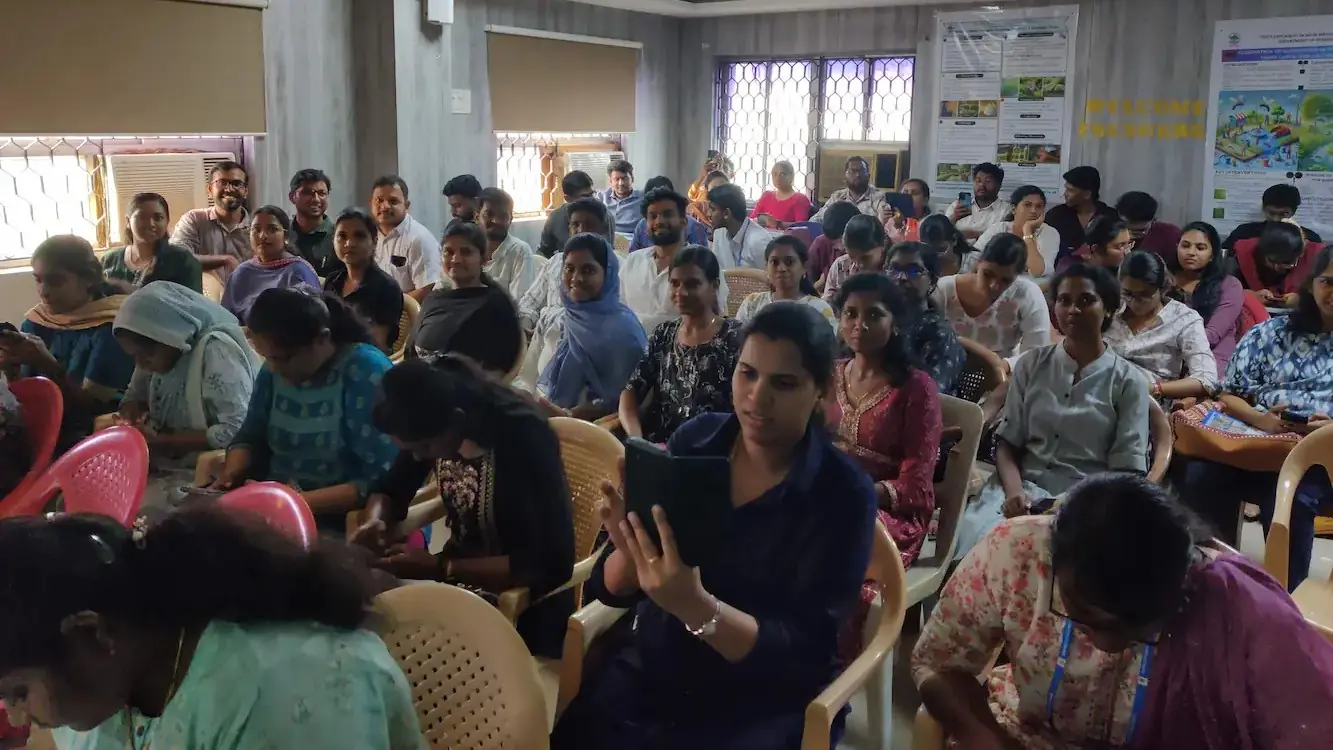
MD scholar waiting in Lecture Hall
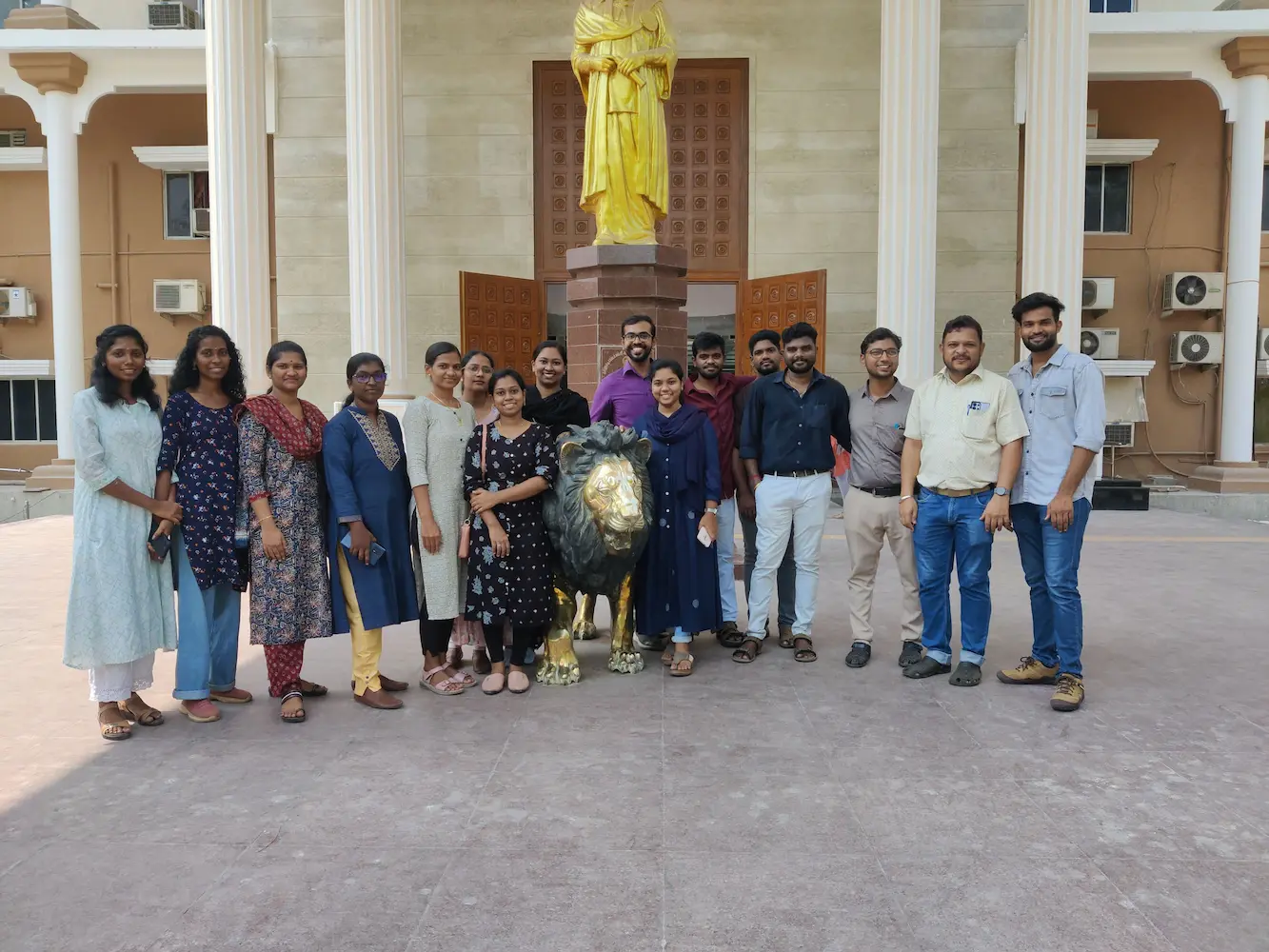
Entrance of the event place
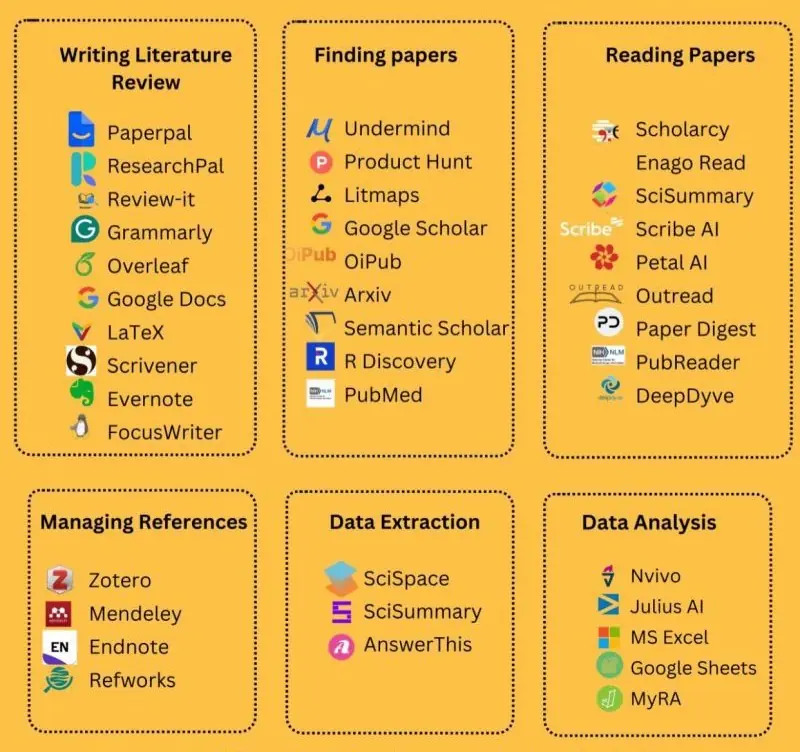
Literature Search Tools, Databases, and AI Assistants
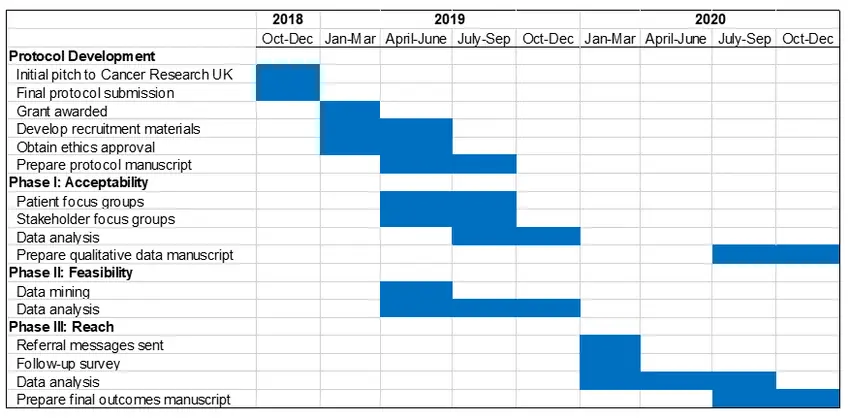
Example of a Gantt Chart for Research Timeline
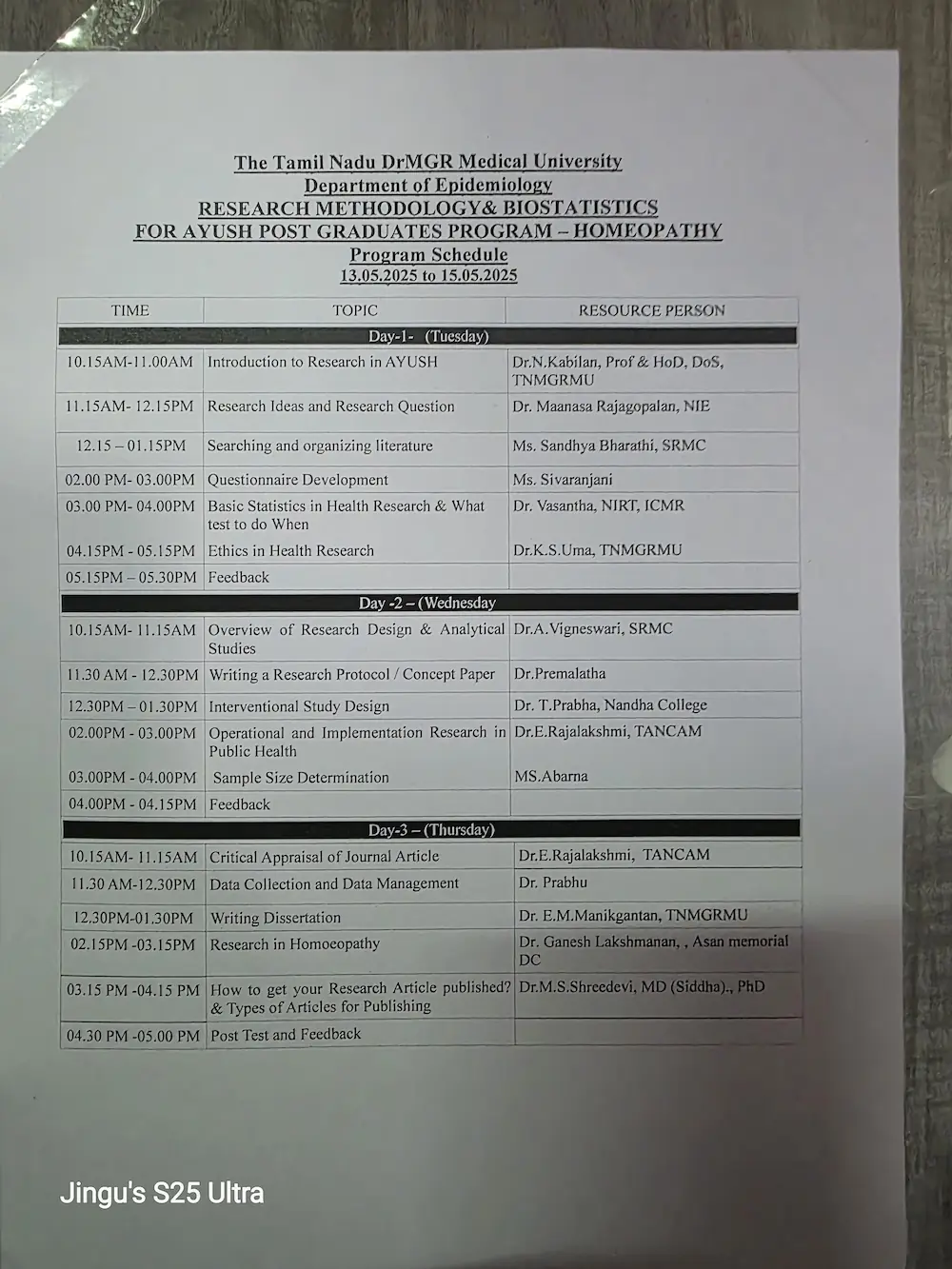
Workshop Schedule